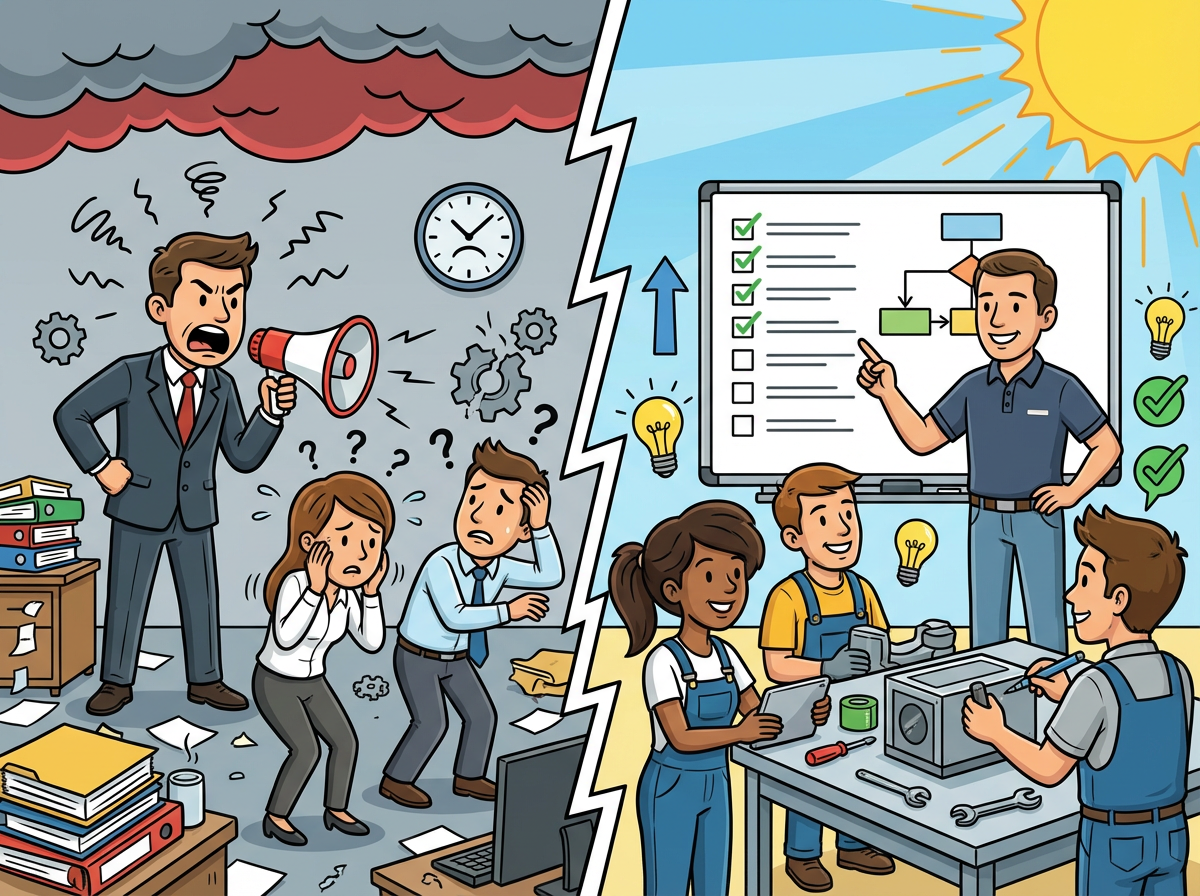

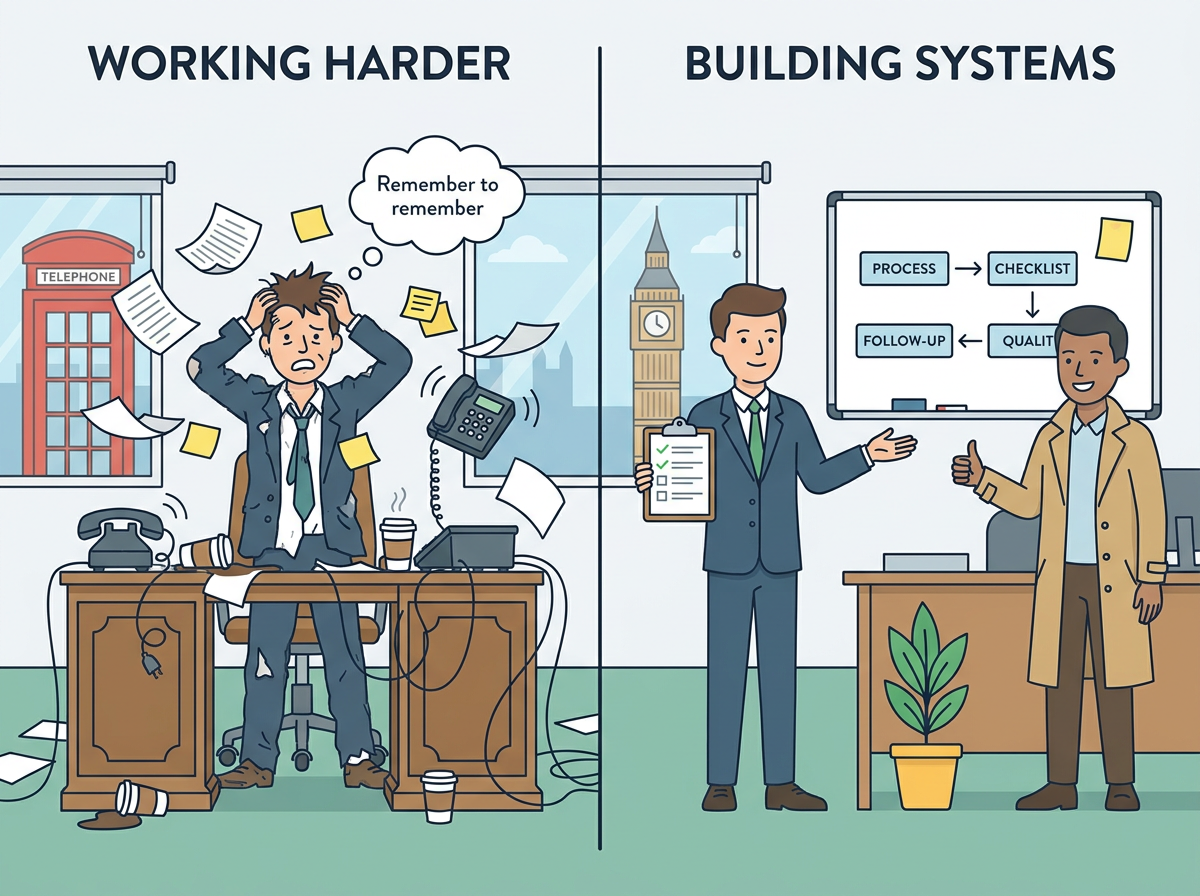

Most business owners don’t have a “work ethic” problem. They have a systems problem.
When things get busy, the default response is to push harder: longer days, more mental juggling, more “I’ll just remember to do it later.” It works for a while. Then it doesn’t. Not because you’re lazy or incapable, but because the human mind has limits — and businesses that depend on memory and heroics eventually hit a ceiling.
Working harder is a short-term fix
Working harder can get you through a crunch. It can’t build a stable business.
The reason is simple: effort is variable. Energy dips. Focus fades. Priorities collide. The more you rely on “extra effort” to keep things running, the more fragile your operation becomes.
A business that only works when you’re at 110% isn’t a business. It’s a personal endurance test.
The human mind is not a reliable operating system
Your brain is brilliant at solving problems and spotting patterns. It’s terrible at being a filing cabinet.
We forget. We get distracted. We misjudge time. We assume we’ll remember something later… and then we don’t.
That’s not a character flaw. It’s normal.
So if your business depends on:
- Remembering what to do next
- Remembering what you promised a customer
- Remembering to chase that quote
- Remembering to follow up after delivery
…then you’ve built a business on a weak foundation.
“Remembering to remember” is a poor customer experience strategy
Here’s a simple test: if you have to remember to remember, it’s not a system.
It’s a gamble.
And gambling is a terrible way to repeatedly wow a customer.
Customers don’t experience your intentions — they experience your consistency. They notice when:
- One job runs smoothly and the next is chaos
- One customer gets a follow-up and the next is forgotten
- One issue is handled fast and the next drags on
When the experience depends on what’s in someone’s head (or how tired they are that day), you’ll get random outcomes. Sometimes you’ll look amazing. Sometimes you’ll look disorganised. And you’ll never feel fully in control.
Luck is not a growth strategy
A lot of businesses run on a mix of good people, best intentions, and luck.
The problem is that luck doesn’t scale.
As you grow, you add:
- More customers
- More orders
- More suppliers
- More moving parts
- More handovers
If you don’t add structure at the same time, the operation gets noisier. Mistakes increase. Firefighting becomes normal. Your best people spend their time patching holes instead of improving the business.
That’s when growth stalls — not because there isn’t demand, but because the business can’t deliver reliably.
Systems are how you protect your sanity
A system is simply a clear, repeatable way of doing something that matters.
Not a 40-page manual. Not bureaucracy. Not “process for the sake of process.”
A good system does three things:
- Makes the next step obvious: So work doesn’t depend on memory.
- Creates a consistent outcome: So customers get the same quality every time.
- Reduces decision fatigue: So your brain is free to solve real problems.
When you systemise, you stop carrying the business in your head. That’s the real win.

What systemisation looks like in practice
Systemisation doesn’t mean changing everything at once. It means choosing the right few things and making them steady.
Start with the areas that cause the most stress and customer risk:
- Quoting and order handover
- Scheduling and priorities
- Quality checks
- Customer updates
- Handling issues and rework
Then build simple “anchors” that make the work repeatable:
- A one-page checklist for the critical steps
- A standard template for customer updates
- A clear definition of “done” for each stage
- A weekly routine to review workload and constraints
If you can’t explain the process in plain English, it’s not ready to be a system.
The long-run payoff: calm, control, and capacity
Clear, steady systemisation gives you something working harder never will:
- Predictability (you can plan)
- Consistency (customers trust you)
- Capacity (you can grow without breaking)
- Sanity (you can switch off)
And it doesn’t remove flexibility — it creates it. When the basics are handled reliably, you have the headspace to deal with the unexpected.
A practical next step
Pick one customer-critical process and answer these questions:
- Where do we currently rely on memory?
- Where do handovers go wrong?
- What do we do differently when it goes well?
- What’s the simplest checklist or template that would make “good” the default?
Build that. Use it. Improve it.
Because the goal isn’t to become a bigger version of “busy.”
The goal is to build a business that runs well — even when you’re not pushing yourself to the limit.