
Process improvement projects can often feel overwhelming—especially when you’re not quite sure how to get from where you are to where you want to be. Many teams freeze at the first hurdle, convinced they need all the answers before making a start. But in reality, progress comes from taking small, practical steps and learning along the way. This is the heart of the continuous improvement process.
When the Path Isn’t Clear, Focus on the Outcome
Recently, I found myself in a situation where no one on the team knew exactly how a particular computer program was going to work. The details were fuzzy, but the outcome we needed was crystal clear. Rather than getting bogged down by uncertainty, we focused on the result and took the first step forward.
Using Plan Do Check Act (PDCA) to Drive Progress
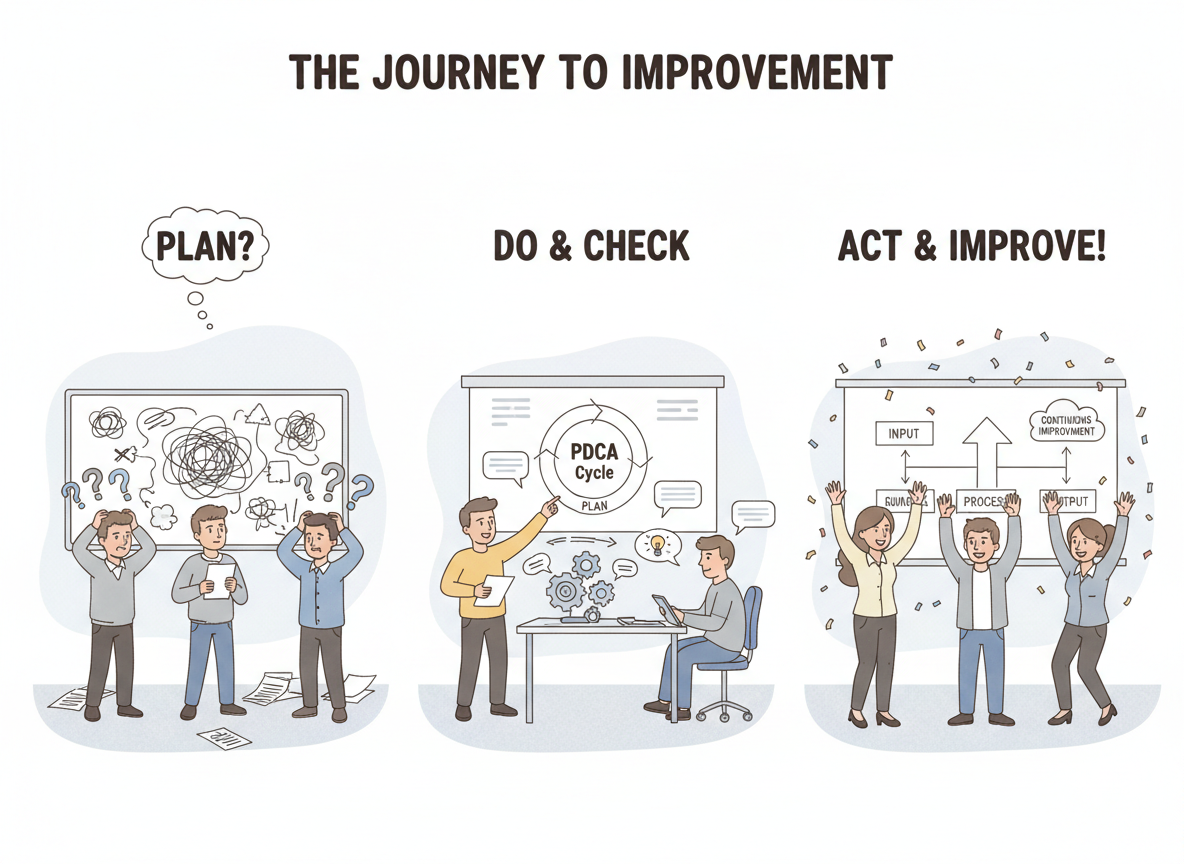
We relied on the tried-and-tested Plan Do Check Act (PDCA) cycle. Here’s how it helped:
- Plan: We clarified the result we wanted and mapped out a simple experiment to test a possible solution.
- Do: We implemented the experiment, knowing it wouldn’t be perfect.
- Check: We reviewed what happened, looking for lessons and clues.
- Act: We adjusted our approach based on what we’d learned, ready for the next cycle.
Bit by bit, this cycle of experimentation moved us closer to our goal. Each step revealed new information, helping us refine our approach and build momentum.
Linking to Business Process Reengineering
This step-by-step approach echoes the principles in my book, Business Process Reengineering. It’s about breaking down big challenges into manageable actions and embracing a continuous improvement process. You don’t need all the answers at the start—just a willingness to try, reflect, and adapt.
Practical Tips for Your Next Project
- Start with the outcome: Be clear about what you want to achieve, even if the path isn’t obvious.
- Embrace experimentation: Small tests are less risky and more informative than big leaps.
- Use PDCA: This simple cycle keeps you moving forward and learning.
- Celebrate progress: Each step is a win, even if it’s not perfect.
And, what happened in my example? The team tested something, learned something, tried again and made some progress. They now know the next few steps ahead!
If you want to learn more about building momentum in your process improvement projects, check out my book, Business Process Reengineering, for practical frameworks and real-world examples.
Remember: Continuous improvement isn’t about instant perfection—it’s about moving forward, one step at a time.
Available from Amazon and all other online stores